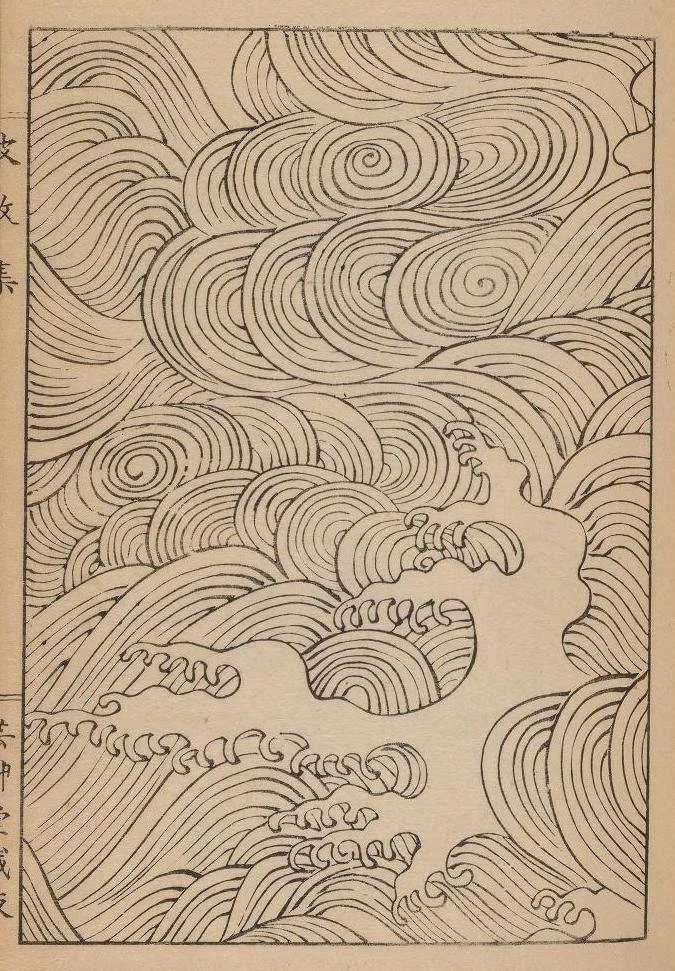
Whirlpools in the Ocean of All
An imperfect allegory about perception and lived experience during a time of surface turbulence.
To experience of the luminous void is to be a whirlpool at the surface of the ocean that opens out and downward to reach the bottom of the ocean.[1] The whirlpool that has touched the ocean bottom will experience the turbulence of the surface differently. When one is aware of and moves through more ocean, surface turbulence is placed in a different context than one who perceives the surface turbulence as a totality. I find it helpful to think of these two distinct ways of perceiving and finding coherence within reality as vertical and horizontal. One mode of perception is not better than another; they are simply different manifestations of the All.
Some of what follows coincides with much that has been written elsewhere, but I write only from my embodied knowing, not from readings.
Most people in this earthly realm chose to engage their reality horizontally; that is, rhizomically—through relationships, society, historical context, and communal time (e.g., religious and national holidays, sports seasons, voting, coronations, and so on). Matrix is a perfect term for this rhizomic mode of perception and relation, and it is not inherently dystopic or “fallen.” It is simply the manifestation of the anterior realms (often considered the upper or heaven realms) in matter, with the help of the elemental realms. It may involve stewardship of the land and its spirits, and reciprocal relationality with others and with Earth herself. When coherent and conscious, these people find great comfort, stability, and fulfillment living thusly.[2] They may know that verticality exists, but do not need to engage it. It is Source knowing itself through width, versus depth.[3]
People who are more vertically inclined, by which I mean those who have touched ocean floor and choose to change their lives irrevocably, find coherence through engagement across dimensions and self-ignition, rather than through relational exchange and external input.[4] Verticality is characterized by vertical and inward moving energy that compresses and, when ready, expands and pulses outwards with expression; the energy and influence is piercing, highly concentrated, and very narrow. This narrowness explains why many vertically inclined people remain virtually invisible or only partly discernible.[5] Conversely, horizontality is characterized webbing, mirroring, and echo; the energy and influence diffuse over a broad surface area. People who have large horizontal diffusion are defined by high visibility.
This is a world populated mostly by horizontally inclined people, as it should be, because it is the realm where Source has chosen to forget Itself. To be vertically inclined is to remain an actor in the dream while knowing phenomenologically (which is deeper than intellectual knowing) that it is a dream. Earth would no longer be Earth if most people experienced the dream this way. But a realm with absolutely no vertical whirlpools would have a harder time remembering that it is also ocean. Earth is not a realm of total forgetting, and so there have always been those who carry within them the map home. This map is within every person, but it remains a kind of encrypted zip file for most. I do not yet know why this zip file opens for some and not others. Some say that one chooses whether it will be opened before this lifetime, others say ego-breaking trauma opens the door for its potential, and still others have opened their zip file through intense meditation, prayer, and other techniques.
In a world organized almost entirely by horizontality, it requires devotion to maintain verticality, even when verticality is one’s home architecture. Many vertically inclined people choose some form of horizontal engagement; they have to, in order to remain in this world. Teresa de Avila, who metaphorized verticality through the metaphor of the interior castles, still engaged horizontally to influence the convent system. Socrates also engaged horizontally by teaching. He aptly describes verticality as a reorganization of perception, not an identity or a role. Joan of Arc, guided by beings from other dimensions to fulfill her origin function, acted from verticality.
In particularly tribal horizontal societies, those who live vertically are a threat to the tribe, and so they may be excommunicated or executed to protect the horizontal weave. Because these horizontal communities have their own gods—the patriarch, a distorted version of God as a Man in Robes, the boss, the news, capitalism, dogmatism disguised as science and atheism—a vertically inclined person who has touched God-Source constitutes a threat to the hierarchy. For this reason, many have chosen to exile themselves in hermeticism or have hidden their experiences entirely.
I, like many others across history, have chosen to live with this devotion and to engage horizontally only when it reflects specific origin function and feels mutually nourishing. Not because this is inherently better, but because forcing a horizontal structure on a vertically inclined system is physically taxing and even painful (literally). Imagine the one who has been outside of the cave pretending that the shadows on the wall are all of reality.[6] It would be a somatic mismatch and the organism rejects it. Devotion is, in this sense, about physical health as much as about what people call spirituality.
As I understand it, the experience of non-duality is the same for everyone, because it is singular. But the routes back to embodiment are multiple, since the One chose to refract into increasing complexity. My route back into my body after experiencing the luminous void is not another’s route back. I did not consciously choose my route back, but it is fascinating to consider that I had always been influenced—by how I acted, moved, and made choices in the world—by the archetypes, figures, and architectures I encountered in mystical visions, even before the first encounter. My “meeting” them later in life felt like both remembering them and a choice-point: would I commit to further devotional embodiment of the architectures they represented?
For more on the routes back in relation to deities, angelic architectures, and other realms, as well as how it all connects to one’s calling or origin function, go through the threshold.
If you wish to reprint (part of) this pulse or to engage for another reason, feel free to reach out here.
_______
[1] What I’m calling “luminous void,” others have called God-Source, Source, and nothingness. The nothing before light, sound, or form. It is the ultimate potential before first breath. I also experienced the white pillar of light of the All, which differs from the luminous void in that it feels more like the All rather than Emptiness. It is total culmination, rather than total potential.
[2] This is not about extroversion versus introversion, and other psychological descriptions. An introverted person may be entirely horizontal, either consciously or unconsciously.
[3] Unconscious horizontality often does not feel stable or coherent; it is the unconscious adoption of surface (the third dimension of matter perceived solely by the five senses) as the totality and usually involves the denial that anything beyond surface exists at all. Unconscious horizontality relies on the looping of scripts and relationships that congeal, rather than respond to new information.
[4] The verticality I describe here is not to be confused with social hierarchies and power structures, including spiritual ones.
[5] For instance, many flatten Socrates’s allegory of the cave as a commentary of the society that would end up executing him. But a vertically inclined person will immediately recognize that the allegory of the cave also refers to how verticality transforms a person’s perception permanently to include a broader bandwidth of light and frequency. Both interpretations remain, but one is horizontal (socio-political commentary) and the other can perceive both the horizontal and the vertical (multi-dimensional perception) interpretations. Thus, Socrates’s message was only partially discernible to some of his listeners and readers across time. The full depth remains cloaked.
[6] Where I depart from Socrates is his suggestion that all who remain horizontally inclined are prisoners. (Though, given his execution, he could be forgiven for his pointed critique of his society.) Unconscious horizontality is tribal mentality in the worst way; it punishes anyone who does not fit congealed scripts. In relationships led by unconscious horizontality, people never actually feel seen and supported, because no one is seeing anyone. People cease to be dynamic organisms responding to surrounding stimuli and information, becoming, instead, walking bundles of fixed identities. And it operates in every community, no matter the political inclination. People who are consciously horizontal remain flexible about others and themselves. They respond to real-time information, rather than by placing overlays on the other.
Image: Untitled by Mori Yūzan (1903).